Posts

Stealing To Be Creative

Image
No one is an island. No one lives in a complete vacuum. This is especially true today with the internet and instant communication & information from around the world. So what's an artist to do but take full advantage of this! There's a great little book out there (a New York Times best seller) called, Steal Like An Artist . It details various ways to rev up your creativity by stealing ideas from others. This is not blatant copying to pass it off as your own, but stealing ideas to inspire your own ideas. Artists of all genres have been doing this probably for the history of mankind. I know I've always done it and still do. I think back to when I was younger, stealing a drum beat or a fill off a record of my favorite band. Yeah, all musicians do that. It's a part of the process of learning. We all learn from what's come before us and, as the saying goes, stand on the shoulders of giants . But the real key here is learning to change something, to tweak i...
Advice on Practice, Performance, and More

Image
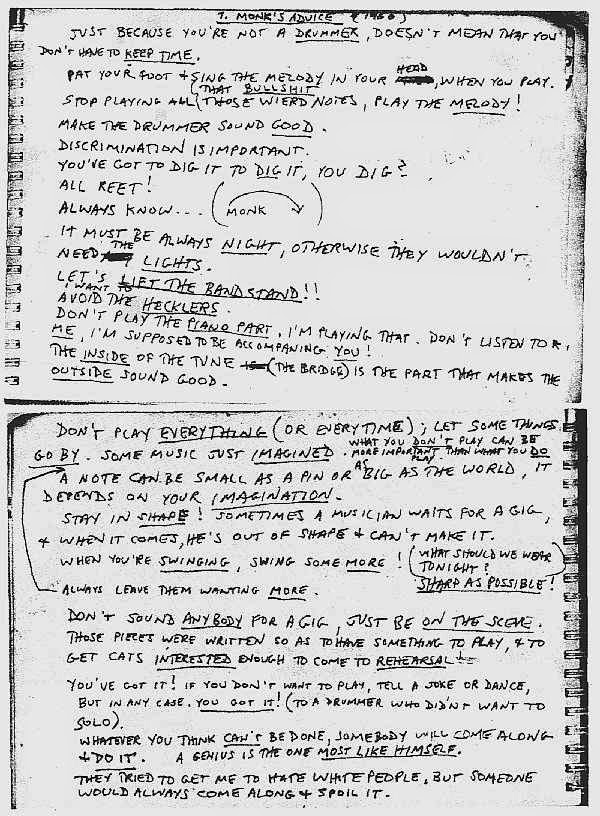
Sometimes sage advice, especially from the Masters of their art, deserves to be repeated. Here are 3 different sets of rules/tips from 3 amazing artists: Thelonious Monk, Steve Lacy, and John Cage. While they are written more with music/musicians in mind, they can be adapted to any sort of art & creativity. Thelonious Monk’s advice to saxophonist Steve Lacy (1960)   Steve Lacy's Tips on Practicing - Teaching is an act of generosity; it is awareness that one has something to give, and adesire to give it. - Music knows no limits. Don’t set up exclusionary boundaries. - Practice slowly. Practicing slowly holds it own technical challenges-and makes even more difficult demands on the spirit. It calls for patience when the world demands results, and quiet single- minded focus in the face of huge repertoire demands. It is the ‘Zen’ way. - Strive for straightforward purity and logical simplicity. - Find rhythm in more subtle forms than a metro...

The Conflagration of Blog/Post/YouTube Haters

Image
We are living in a crazy world where things change rapidly and just about any and everything is available to us via the internet. While our world is filled with wonders, it's also become filled with haters. I read a lot of blogs and watch a lot of videos of musicians and artists. One thing I'm really disturbed by is the amount of comments that, besides not being constructive, just spew hate. It's one thing to leave a constructive criticism, it's another to just leave comments like, "Your drumming sucks!," or, "I hate XXX drums/cymbals and you suck for playing them." As you may know from reading this blog, I'm not big on all the Karaoke drumming videos out there, but I've never left a negative comment on any that I have watched. Instead, I might say something like, "Nice playing, I'd love to see something original or with a band." Too often the haters will jump in and reply in such a spiteful way. Do we really need t...

Modeling

Image
This post was inspired by something I read on a cello blog [I happen to read a lot of different music & art blogs, because you can always find inspiration & ideas you can use]. The idea was that we always tend to worry too much about the little technical things, like how we hold our arms/hands, or how we do certain techniques. One way to get away from that is to think about the bigger picture . This is where modeling comes in. I know this from personal experience. I remember years back when I saw a full page photo of Tony Williams in DownBeat magazine. Tony was sitting there in a very upright posture, with his back straight. Now as a known sloucher , this photo had a big impact on me. With much respect for Tony and his drumming prowess, I was really taken by this photo. The other aspect of it is he looked like he was in charge up there, like he knew exactly what he was doing. Confidence.  Tony, looking regal on the throne. Above, is either the same, or a very simi...

Thoughts About Cleaning And Maintenance

Image
Summer is almost here and I'm back at my part time summer job, which is working for a local music store that I teach at. They have an huge school rental program and my job is to clean up and repair all the rental snare drum and bell kits that students have used over the past year, and get them ready for both summer music programs, and the fall semester. So I thought this would be a good time to talk about cleaning your gear and taking care of it. A small pile of kits to be worked on. There will be hundreds more,  stacked floor to ceiling, within the next 2 weeks. The glamorous life: cleaning percussion. The 1st thing is tools: besides a drum key, quality screw drivers (in both flat & phillips) are a necessity. It's also nice to have a pliers, a few wrenches to fit what you are working on, and a hammer, just because you might need a hammer, and maybe an electric drill with a drum key bit if you are changing a lot of heads. I also have a box cutter knife ...

Music Notation for Gongs

Image
Recently, I was asked a question about how Gongs are notated in a musical score. Here are various examples of different ways they have been notated, from traditional classical, to modern musical forms. The first thing is to differentiate the 2 main types of Gongs: the flat faced, usually termed Tam Tam in a classical score, and the Bossed Gong, with a raised center boss (AKA cup, nipple). A good example of a traditional symphonic Tam Tam part would be from Gustav Holst’s, The Planets . This example is from Mars, the Bringer of War : We can see the Gong/Tam Tam notated traditionally on a single staff line.  The next example is from Puccini’s opera, Turandot . This is the Tam Tam part, notated on the bottom line. Example #3 is also from Turandot. The score also calls for Tuned Bossed Gongs. Unfortunately I was unable to find a score example of them. John Cage used various Gongs in his percussion music. This is an example of how he notated ...

Be Yourself Because You Are The Best YOU

Image
When any artist starts out, they copy those who came before them in order to get a foundation for what they do. And this is fine. We all should have a sense of history, a sense of what came before us to lead us to the present moment. But there comes a time when most of us should cut the cord and go off on our own. The main problem with copying someone is that you will always be a copy, not an innovator. And even if you keep up with the latest things, the originator will always be one or more steps ahead of you. Your artistic life will either be stagnant in one place, or in a state of perpetual catch up.  I always find it interesting when I come across someone copying something I do, or did. In fact, just a while ago I found someone online who had copied the verbiage from my brochure almost exactly. At first I was shocked, then a bit angered. But then I got over it because I realized that I had already moved beyond what they copied, so they were taking old ideas. "You c...