Friday, May 11, 2012

The Art of Recording, Part 3

First, let's review my 5 rules for recording:
  1. Preplan everything
  2. Preplan some more
  3. Work fast
  4. Work hard
  5. Nothing is out of bounds—be creative!
Oh, did I mention to preplan? No matter what type of recording, being well rehearsed, and having a game plan can save you both time and money. This worked out well back in September, 2007, when I recorded 3 complete and different CDs in one 12-hour marathon session. How did I do it? Lot's of planning. Yeah, I can get kind of nerdy with my planning things, but can you ever really plan enough? 


A Tale of 3 CDs


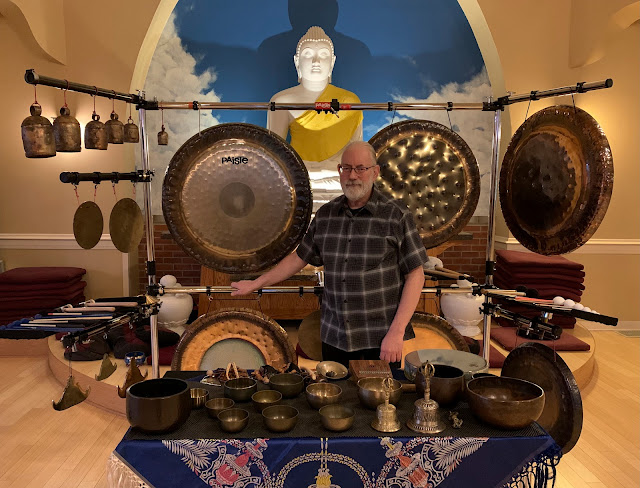
The first thing I did was to work with a studio and an engineer I was was familiar with (both my mother-in-law, who is a jazz singer, and my singer/guitarist son had recorded there). Then well before the session, I spoke to the engineer, Chris, about what I wanted to do, and also said that I would send him a plan (I've included a copy of the plan at the end of the blog for your reference). So I put together a recording plan with details of the Gongs I would be using and the music I'd be recording. I also sent along copies of my previous recordings so he would have an idea of what I was after. I wanted to make maximum use of my time for recording, not debating things. This also gave him time to think things over and come up with his own ideas.

My son Aiden came with me and we quickly had all the gear brought in and set up. Then I played a few things for Chris to listen to and get a sound idea on. He brought out different mics and we tried a few short things to see what kind of sound we could get, and find something workable. I left the miking ideas up to him, and for most of the recording, we went with some Cascade Fathead ribbon mics set up in a Blumlein Array. This really captured the live sound of what I do. 


Cascade Fat Head Ribbon mics in a Blumlein Array

The 1st thing we recorded was my MERIDIAN CD. This was various Gong compositions and improvisations, using my whole Gong set up, (including the Philippine Kulintang set), as well as Tibetan Singing Bowls and some Bells & Cymbals. The Blumlein set up worked great for just about everything. The nice thing is that it kept the sound and the soundfield consistent for the whole CD.


Discussing little details of the Melodic Gongs with Chris, the engineer


Recording "Spiritual Resonance"


Recording "Calling The Spirits" with Blumlein Array in the foreground

Next up was MANDALA, a one track meditation CD.  After clearing away the things I wouldn't need, we just did a quick check and I played non-stop on the large Gongs for nearly 50 minutes. I knew things went well when I went into the control room and both Chris, and my son, were zoned out. Chris was like, "You'll have to give me a few minutes before we do the next thing."

The next thing was my MICROCOSM CD. This used a very different approach. Each of the 9 tracks was played on just one Gong played with friction mallets. My idea was to close mic things to pick up all the subtle vibrations that I hear, but an audience doesn't. So for each track we positioned a Gong on the stand and then used 2 mics only inches from the back of the Gong to catch the vibrations. On the final track, we had my son Aiden move a mic around the face of the Gong while I played it to get some interesting sonic variations (and as a sort of homage to Karlheinz Stockhausen's "Mikrophonie").


When all was done, we took a short break to pack and load the gear back in my van, then proceeded to mix all 3 recordings. Since most of this was 2-track recording, it was more a matter of adjusting levels & EQ than actually mixing anything.


So the end results was that almost everything was a 1st take, because I was rehearsed and ready. Also, the inspiration level ran high, so the improvised and experimental pieces were easy to capture.


~ MB


This is from the actual pre-session notes I sent to Chris, the engineer:


Michael Bettine - Studio Recording September 8, 2007
Chris,
Here are my ideas on recording: I want to record everything live with no overdubs or later additions. I’m looking to capture the sound of the Gongs as they are in the studio. In past recordings I added just a bit of reverb to fill out the overall sound, but otherwise it’s pretty straight forward. I have some micing suggestions from previous experience, but am certainly open to your ideas. As I said, the idea is to capture the acoustic sound of the Gongs in the room.
I have everything organized and rehearsed. My past recordings have been basically 1st takes. I want to record 3 separate projects:
Project #1 Meridian: 
1 - Kulintang - 5-6 pieces - 20 minutes
2 - Melodic Gong Play - 3 pieces - 15 minutes 
3 - Large Gongs - 6 pieces - 30 minutes. There will probably be a few improvised pieces built around some ideas I’m working on. We’ll see what happens.
Project #2 Mandala: 
4 - Large Gongs - 1 piece - 50 minutes - 1 take. This is a soundscape thing I do for meditation/healing that moves from Gong to Gong and is just one long piece.
Project #3 Microcosm: 
5 - Large Gongs - 9-12 improvised pieces - 40-50 minutes. This will be different - all close miced, one Gong at a time. I’m looking to pick up the quieter harmonics/overtones that are only heard up close.
I’m always open to providence, accidents, improvisation, and outside ideas, so we’ll follow the plan, but go with what presents itself in the moment. This will be a lot of fun.
I’ve enclosed photos of the Gong set ups I’ll use. They’ve changed a bit, and some Gongs will be changed during recording, but these are the basic set ups. You can get an idea for miking, etc.
Project #1 - MERIDIAN
1 - Kulintang - 5-6 composed pieces - 20 minutes total (1 track with woodblock). Gongs are 7-9˝ in diameter.
2 - Melodic Gong Play - 3 composed pieces - 15 minutes. Gongs are 6-20˝on diameter.
3 - Large Gongs - 6 pieces - 30 minutes. Gongs are 18-32˝ in diameter.

Project #2 - MANDALA
4 - Large Gongs - 1 piece - 50 minutes - 1 take
Project #3 - MICROCOSM
5 - Large Gongs - 9-12 improvised pieces - 40-50 minutes
Additional pieces: I’m working on a piece with 6-8 Gongs laid on the floor to mute them.
Also a possible piece with 1 Gong played by hand like a frame drum. I might also add some cymbals or percussion on some tracks. A lot depends on what I come up with between now and the session. But this basic list shouldn’t change much.


Sunday, May 6, 2012

The Art of Recording - Part 2

OK, I meant to post this follow up to January's Part 1 much sooner than we have here, but hey, life happens when you make plans.

So let's talk about getting things down. I'm going to use 2 completely different examples of how I work. The 1st is live in the studio, the 2nd is multi-tracked.

Live in the studio: My 1st solo percussion album, Stars Show The Way, was a quick affair. It was recorded and mixed in one 8-hour session. Now owing to budget constraints, that's usually the way I work. I don't have any record label or financial backing other than myself, so I make the most of my time vs. money.


Stars was recorded at the home basement studio of someone I worked with in a music store at the time. They were excited about the opportunity of recording my music/instruments (because, let's face it, it's pretty unique), and willing to experiment. Now this was important for me, because I don't need an engineer who just wants to just get down a rock drum sound—I'm so not about that. So I must thank Joel and his studio partner, Paul, for doing such an excellent job!


The other real important thing is that I trusted the ears and skill of the persons doing the recording. And even though this was done at a small home studio, they had decent equipment, and more importantly, they knew how to use their equipment! I'd much rather work in a small studio where the engineer knows how to get the most out of their gear, than in a multi-million dollar studio with a hack engineer. As in musical performance, I believe the sound is in the person more than in the gear used.


Overhead mics on drum kit & Gongs

So the theme here was live. I had a selection of material that I had been writing and playing at drum clinics and a few gigs. The rest would be improvised around ideas I had. So the actual process was pretty easy: set up just like I would for a live gig, hang some mics, and record. We went with some room mics on the drums and on the Gongs, then had a solo mic for specific small percussion. I ran through a few things to get levels, then just played. Mind you, I was well rehearsed and had extensive notes on what I wanted to do, so it was more of a step by step process, moving from one thing to another. 


3 overheads on the drum kit, mic behind the Water Gong in center of photo. 

The album had a number of short, improvised pieces I called "Small Gestures." These were mostly inspiration on the spot. I'd just say, "Hey, let's try this," and we'd hit 'record.' I ended up recording 25 tracks (13 - Small Gestures), all of them 1st takes except one, where we had a technical issue and I had to start over again (I said I was prepared).  The mixing stage was really just balancing the stereo image between the various mics and adding a bit of reverb to give the final sound some space.


Now one other thing I need to stress, beside the importance of being well rehearsed, is having great sounding instruments. All my Gongs are hand-picked by me to meet certain sonic requirements. All the drums I use are well tuned—it's amazing how many drummers can't tune their drums. So for me, it's really as easy as just sticking up some quality mics to capture both the sound of the instruments, and the air around them. This is not a rock/pop recording, so other than a little reverb, there is no processing or modifying of the sounds. 


It's also important to have a very good ear (I do), and to work with studio engineers with good ears who are NOT stuck in that rock drum sound mode. This is probably the most important thing. You can do everything else and not have an engineer who's on the same page as you about sound, and the results will not be what you want. So it's important to check out both studios and studio personnel before you decide where to record. 


Notes & charts for LABYRINTH session.

My next album, Labyrinth, was recorded in the same studio the same way: 1 long 8-hour session, with a couple of hours the next day to mix things. I set up the Gongs and we hung some room mics. Then for a few tracks we positioned specific mics, like on the Kulintang Gongs or a hand played Gong. I played the music, and we were done. Nothing like being prepared.


Stereo miking Gong 'Hand Drum' for "Showers of Spectral Light"

Almost all subsequent recordings were done the same way, either live in the studio, or live on the gig. With this type of recording, I always try to capture my live performance sound. I want my recordings to sound just like I hear things on stage, so the listener can get the same sort of feeling I do.


Gongs in waiting…

~ MB


Addendum: It occurred to me that some people might think my ideas/techniques are overly simple/lo-fi/etc. Well, they are. My feeling has always been that the least things between the sound source and the recording medium, the better. And to reiterate, let's review my 5 rules for recording:
  1. Preplan everything
  2. Preplan some more
  3. Work fast
  4. Work hard
  5. Nothing is out of bounds—be creative!
Now I should add a 6th rule, which would actually come first:


  1. Start with a good sound!


If you are recording acoustic music and have a good (great actually) sound, then it's just a matter of capturing that sound as realistically as possible. For a reference, please click the above links to my 2 recordings and have a listen for yourself. The results speak for themselves.


In Part 3, we'll look at another marathon session where I recorded 3 seperate CDs.

Monday, April 23, 2012

Sound, Texture, Options & Imagination

Welcome to the final installment of 10 Weeks to Better Drumming. I hope these thoughts and ideas have helped you see both your music and drumming in a new perspective, and possibly opened up some new ideas.


What does this sound like?


I'm more about sound & texture than I am about technique. Whereas It seems most people are chasing technique on a daily basis. To me, technique is merely a means to an end. That's not to say technique isn't necessary, but that playing paradiddles at 280BPM isn't the end all, be all, of drumming. I would rather have reasonable technique with a good sound, than astounding technique with a poor sound. But then, that's just me.


What does this sound like?


I tend to obsess over sound & texture the way most drummers do over technique. No matter what instrument I'm playing, I am always looking for both a good sound from it, and possible new sounds. Texture is another world entirely. I have bags full of different sticks/brushes/mallets/implements that I use to get different sound textures with.


What does this sound like?


Let's look at some Options & Imagination using these different Sound & Textures:


Take your favorite beat/song/solo and change the sound textures: use a timpani mallet in one hand and a Blastick in the other. Go ahead, play it. Notice the different sounds, the different textures. 


  • Does this change the feel? 
  • Does this change your approach to playing it.
  • Does this change how you perceive this piece of music?

What does this sound like?


OK, do this again, only this time with a shaker of some type and a knitting needle. 

  • What changed this time from the last, or the original version?

Let's do it one more time with a bare hand/fingers and kitchen utensil, like a spatula.

  • Again, compare the differences from the previous versions.

What does this sound like?

Now we'll do something different. Place a towel/t-shirt over your snare drum and ride cymbal to muffle them. Then put something on your floor tom, like jingles/beads, that will rattle when you play it. Then play with 2 different implements in your hands.

  • What's happening now, both in the music, and in your head?

Don't be afraid to experiment with your sounds, or to change the textures. This can make old things sound new again, and feel fresh to play, not to mention inspire new ideas.

Thanks for checking out this series/blog. Please do let me know of your thoughts & experiences.

~ MB


Monday, April 16, 2012

Life Beyond the Drums

10 Weeks to Better Drumming - Part 9


OK, so you play drums and have your stuff together. You can swing just like Tony & Buddy, rock just like Neil & Lars, and groove just like ?uestlove & Ndugu. And to prove it, you posted drum karaoke videos of you all over the web playing to your favorite tracks. We're all suitably impressed and I'm sure Jeff Beck, or somebody, will be phoning you shortly to offer you a gig.


But seriously, so many of us are stuck in a box—stuck in a box of drums only. We listen to drums, watch drum DVDs & videos, go to concerts to see the drummers, but we miss out on all the other stuff going around us because we are too focused on just the drums!


I love drums. I listen to a lot of drum recordings, but I also listen to a lot of other music, even stuff without any drums/percussion. As much as I've been influenced by various drummers over the years, I must say that I've been equally influenced by singers, saxophonists, violinists, etc. In fact, in listening to things other than drums I'm always absorbing what they do and trying to bring that back to my drumming.


Singers—I love the human voice and listen to singers all the time. If you want to learn about phrasing, then you need to listen to singers, because they have it down. If you want to learn swing/jazz phrasing, then listen to Frank Sinatra and try to emulate his phrasing. 


I listen to a lot of 'world music' (BTW, I hate that term) because I love how singers phrase things in different languages. You can learn a lot about rhythm & phrasing by listening to people singing in different languages/music styles than your own. Norwegian/Sami singer, Mari Boine, has been a big influence on how I approach rhythm. Her music & singing is very deep and connected to the earth/history. There's a definite organic feel to it.


Another favorite is Finnish Yoiker, Wimme Saari. Check out his music and play along to his singing, emulating the phrasing, the inflection, etc. His solo Yoiking has a whole different rhythmic style than pop or jazz.


Saxophonists—check out John Coltrane, but don't listen to his great drummers (like Elvin Jones & Tony Williams), instead, listen to Coltrane himself. Like the singers previously, work on emulating the phrasing and inflections that Coltrane plays with his sax. Also check out McCoy Tyner's piano playing.


Strings—now this is a completely different realm than percussion. Check out some string quartets and play along to the music, not with typical drum beats, but thinking like a violinist/violist/cellist.


Composers—let's get into a completely different mindset and get into the heads of some original thinking musicians. Check out this documentary on experimental French composer Pierre Henry, one of the pioneers of musique concrète, or the documentary on composer Milton Babbit, one of the pioneers of electronic music.


Now don't just stop there. Get into painters, dancers, writers, sculptors, etc. and draw inspiration from them. Feed your music/drumming with everything. It doesn't matter if you play rock, jazz, metal, country, disco—whatever—listen to and emulate something besides other drummers. Don't just be a drummer, be a musician. Open your ears. Open your eyes. Open your mind…


~ MB

Friday, April 6, 2012

Tam Tam vs Gong

I can't tell you how many times this argument of "A tam tam is not a Gong" comes up. It came my way no less than 3 different times this week.


Actually, 'tam tam' (also tam-tam) was 1st used in symphonic music back in the 1800s to differentiate a flat faced Gong from a Gong with a raised center 'boss.' (There is no definitive answer as to where the term tam tam originated - some say it's Chinese, some say it's Hindi, still others say it's something else…) To add to the confusion, 'tam-tam' is a term often used for either an African djembe or talking drum.

When a score calls for a 'tam tam' (like Messiaen’s 'Et exspecto resurrectionem mortuorum' or various works of Richard Wagner), then a flat faced Gong, like a Chinese Chau, is used.


Flat Faced Chinese Chau Gong/Tam Tam


When a score calls for a 'Gong' (like Puccini’s 'Madame Butterfly', or 'Turandot'), then a bossed Gong, either tuned or untuned (as specified), is used.

Bossed Gamelan (L) & Thai (R) Gongs


Most Asian cultures use a name that sounds like the sound a Gong makes, thus Gong, Agung, Gandingan, Ageng, (see a pattern here?) etc. I don't play in the Symphony, so I don't ever use the term tam tam. To me, all Gongs are Gongs.


Repeat after me: All Gongs are Gongs…


~ MB  


Monday, April 2, 2012

Where We Live

10 Weeks to Better Drumming - Part 8


After the past 2 weeks of looking at both notes and spaces, this week we look at the present, the moment, the now. Too often we seem to be preoccupied by something other than what is happening right now. The best musicians are thinking about and playing the notes as they happen, in the moment. They are living things as they happen, not living in the future, or the past.


Where I used to live…


Don't think ahead, live in the moment/the note you are playing. Too often we are thinking ahead, worried about the next note, the next phrase, the next song. We might also be troubled by "Monkey Mind," where we are thinking of anything but the task at hand. We might be in the middle of a song and suddenly think about a TV show we watched, or the bills we have to pay, or a million other things beside the music.


Where I now live, in the moment…

Or we might even be thinking too much, trying to achieve some sort of perfection, but missing being in the moment and enjoying what we are doing right then and there.


Where I live in the future…

In all of these examples the key is to be in the moment. Don't worry about anything else, just be aware of where you are and what you are doing each moment. Savor and enjoy each note you play as you play it. Don't worry about the notes to come, as you'll get your chance to experience them. The same with notes you've already played - they are history, gone, passed. You can always review them later when you are done, but otherwise, forget them.

Live in the moment. Experience the notes as you play them.

"Be here now." - Ram Dass

~ MB

Monday, March 26, 2012

"Space is the place!" - Sun Ra

10 Weeks To Better Drumming - Part 7


Last week we talked about notes, lots of them, all lined up one after another. This week we want to become more aware of the space between those notes. If you look at drums & percussion, most sounds are very short, so short that with say, a quarter note, we only really play the very beginning of the note. The rest of the note is silence/space. So even in a very busy pattern, we are probably playing more space than actual sound. Now if we play notes far apart, the amount of space between them is huge. 


What do we do with that space?
How do we accurately account for it?


When playing drums, percussion, and especially Gongs in a Meditation context, it's absolutely imperative to be aware of the space, as much as the notes.


Feel the space


Let's look at some exercises to help us become more aware of the space between the notes:


#1 - Start with 1 note and 3 equal notes of silence (you can think of these as quarter notes & quarter note rests)


1 2 3 4 1 2 3 4 1 2 3 4 1 2 3 4 1 2 3 4 etc.


On note 1, play a drum, block, Gong, etc. Count the next 3 notes to yourself, then repeat the sequence. You want to feel all 4 notes, especially the silence. What we want to learn is a sense of time passing, whether there is a sound or not. It's easy to play a lot of rapid notes in quick succession, because they create a certain momentum, and you don't have to deal with the space in between the notes. 


So if you have a metronome, start at 100BPM, with each count getting 1 metronome click. Play with the metronome for a while, feeling the time and the sense of space between each note played. Then turn the metronome off and repeat the same thing. Without the metronome you are free to feel the space between each note, but need to keep track of the passing time.


I'm amazed at how many musicians are daunted by silence, by long space between notes. This seems to be something people rarely think about or work on, they'd much rather work on playing super fast licks and runs of multiple notes. But every musician should fundamentally be aware of both the notes AND the space between those notes.


When you have this down and feel good about it, slow the tempo and increase the space. Bring it down maybe 4 BPM at a time until you get to say, 60 BPM. Now you really have to be aware of the space!


#2 - Increase the number of notes/rests: play in groups of 5, 6, 7, 8, etc., increasing the time between notes played. As above, slow the tempo down. 


Feel the time, be the time, immerse yourself in the time.


Yes, this exercise is very basic, but I'm amazed at all the musicians who do not have the basics down. Work on this, and last week's exercise, for 3 - 4 weeks and you will notice a great difference in how you perceive the music you play.


And remember, Space is the place…


~ MB